What You'll Learn
Von Neumann and Harvard are the two foundational models for how a CPU reaches instructions and data, and nearly every real chip is a variation on one of them. What Is Computer Architecture? introduced both briefly; this tutorial goes deeper: a side-by-side comparison table, honest pros and cons for each, the real chip families that actually use them, and a straightforward way to decide which one fits a given design. It's part of our Computer Architecture series.
On This Page
- What Is Von Neumann Architecture?
- What Is Harvard Architecture?
- Comparison Table
- Von Neumann: Pros and Cons
- Harvard: Pros and Cons
- Real-World Applications
- Choosing the Right Architecture
- Real-World Examples
- Common Mistakes and Misconceptions
- Frequently Asked Questions
- References
What Is Von Neumann Architecture?
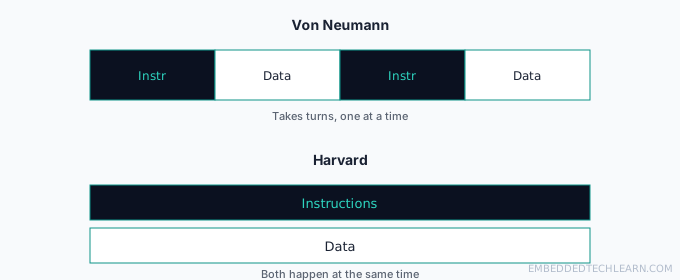
Von Neumann architecture uses a single, shared memory space and a single bus for both instructions and data. The CPU fetches an instruction, decodes it, then retrieves or stores data, all through that same shared pathway, one trip at a time. Picture a single-lane road where trucks (instructions) and cars (data) have to take turns using the one lane available, nothing moves through at the same moment as anything else.
That shared design is exactly what makes Von Neumann simple and cheap to build: one memory space, one bus, no rigid division between "code space" and "data space." The well-known cost of that simplicity is the "Von Neumann bottleneck," the CPU sometimes stalls waiting for the bus to be free before it can fetch the next thing it needs.
This is also why the same memory can hold both a running program and the data it operates on, which sounds unremarkable today but was the actual breakthrough: earlier machines needed physical rewiring to run a different program, while a Von Neumann machine just loads different data into the same memory space it always uses.
What Is Harvard Architecture?
Harvard architecture uses physically separate memory banks and dedicated buses for instructions and data. Using the same road analogy, this is a two-lane road: trucks (data) use one lane and cars (instructions) use the other, both moving at the same time without either one blocking the other. This lets a Harvard-style CPU fetch the next instruction and read or write data in the very same cycle.
That parallelism doesn't come free. Separate buses and memory banks mean more circuitry, more physical routing on the chip, and less flexibility for software that wants to treat memory as one continuous, freely addressable space (which general-purpose operating systems do constantly).
The separation also has a subtler benefit beyond raw speed: because instruction memory and data memory are physically distinct, a runaway program can't accidentally overwrite its own code the way it sometimes can on a Von Neumann system, which is one more reason safety-conscious embedded designs lean toward Harvard-style chips.
Comparison Table
| Feature | Von Neumann | Harvard |
|---|---|---|
| Memory layout | Single shared memory for code and data | Separate memory banks for code and data |
| Bus system | One unified bus | Two (or more) dedicated buses |
| Execution | Sequential, bottleneck risk | Parallel fetch, no shared-bus wait |
| Hardware cost | Simpler, cheaper | More complex, more expensive |
| Memory space usage | Flexible, no fixed division | Fixed division can under-use space |
Von Neumann: Pros and Cons
- Pro: Simpler and less expensive to implement.
- Pro: Flexible memory usage, no space wasted on a fixed instruction/data split.
- Con: The shared bus creates a bottleneck when both instructions and data are needed at once.
- Con: Performance can suffer under high memory-throughput demands.
Harvard: Pros and Cons
- Pro: Higher throughput through genuine parallel access.
- Pro: Predictable timing, valuable for real-time and signal-processing work.
- Con: More expensive hardware due to the added circuitry.
- Con: Fixed-size code/data memory regions can go under-used if a program doesn't need the full split.
Real-World Applications
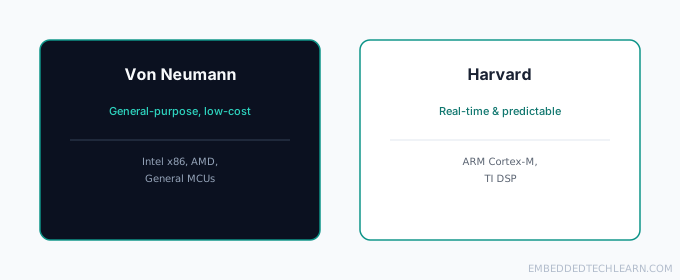
Von Neumann: Intel x86 and AMD desktop and server processors, and most general-purpose microcontrollers found in PCs and laptops, all lean on the flexibility a shared memory space provides. These systems run an operating system that has to load, unload, and reshuffle arbitrary programs constantly, exactly the workload a single flexible memory space handles well.
Harvard: ARM Cortex-M microcontrollers, digital signal processors like the TI C6000 series, and FPGA soft cores built for critical timing all use Harvard-style separation, since predictable, simultaneous instruction/data access matters more there than raw flexibility. These are almost always single-purpose systems: a sensor node, an audio processor, a motor controller, running one job for its entire operational life rather than juggling arbitrary software.
Notice the pattern: the choice tracks the actual job a chip has to do far more than it tracks how modern or advanced the chip is. A brand-new desktop CPU and a decades-old mainframe can both be Von Neumann for the same underlying reason, they both need to run varied, unpredictable software on the same hardware.
Choosing the Right Architecture
In practice, the decision comes down to what the system actually needs to do:
- High-speed, predictable performance: Harvard.
- General-purpose computing running varied, unpredictable software: Von Neumann.
- Budget-conscious, simple tasks: Von Neumann.
- Mission-critical timing or heavy parallelism: Harvard.
Most real microcontrollers split the difference with a modified Harvard design: Harvard-style separation where it matters for performance, with enough Von Neumann-style flexibility layered on top to stay practical for general software, see What Is Computer Architecture? for exactly how that middle ground works.
Real-World Examples
Example 1: A Desktop Gaming PC
An Intel or AMD desktop CPU uses a Von Neumann-derived design, prioritizing the flexibility needed to run an operating system, a browser, a game, and background processes, all completely different, unpredictable programs sharing the same memory model. Deep caches and aggressive scheduling exist specifically to hide the Von Neumann bottleneck at this scale, since a modern game genuinely needs both instructions and data moving constantly.
Example 2: An Arduino Uno
The AVR microcontroller inside a classic Arduino Uno uses genuine Harvard architecture: separate flash memory for program code and SRAM for data, each on its own bus, letting the chip fetch an instruction and access data in the same cycle despite a modest clock speed. There's no operating system juggling other programs, so the chip's entire architecture can be built around running one fixed sketch predictably, forever.
Example 3: A Hearing Aid's Digital Signal Processor
A hearing aid's DSP has to process incoming audio continuously and predictably, any timing hiccup is audible as a glitch. Harvard-style simultaneous instruction and data access is exactly what makes that guaranteed, glitch-free timing possible on such a small, low-power chip, where there's no room for the unpredictable stalls a shared bus can introduce.
Example 4: A Legacy Mainframe
Early mainframes were the original Von Neumann machines, literally the design John von Neumann's 1945 EDVAC report described: one shared, reprogrammable memory holding both the program and its data, replacing earlier machines that had to be physically rewired to run something different. That single idea, that a program is just data sitting in the same memory as everything else, is what made general-purpose, reprogrammable computing possible in the first place.
Example 5: An FPGA-Based Motor Controller
A motor control system built on an FPGA soft core often uses a Harvard layout specifically so that control-loop timing stays deterministic, the system can guarantee it reads a sensor and updates motor output within a fixed number of cycles, every single time, with no shared-bus contention to introduce variability. A motor spinning out of control because an instruction fetch got delayed behind a data access is exactly the kind of failure Harvard architecture is built to rule out.
Common Mistakes and Misconceptions
- Assuming Harvard is a strictly newer or better idea. Both models are decades old; each answers a different constraint, not a timeline of "improvement."
- Assuming every microcontroller is pure Harvard. Most modern ones are modified Harvard, a practical blend, not the strict textbook version.
- Judging the choice purely on raw speed. Cost, flexibility, and timing predictability often matter more than peak throughput for a given design's actual requirements.
- Assuming this is a software decision. It's fixed in the chip's physical design; software has to work within whichever model the target hardware actually uses.
- Picking an architecture based on marketing rather than the actual workload. A chip described as "Harvard" isn't automatically the right choice, if the job genuinely needs general-purpose flexibility, that separation can just add cost without a real benefit.
- Forgetting that "modified Harvard" is the realistic default. Very few real microcontrollers are pure textbook Harvard; assuming a strict, total instruction/data separation can lead to wrong assumptions about how memory addressing actually works on a given chip.
Frequently Asked Questions
Is Harvard architecture always faster than Von Neumann?
Not in every sense. Harvard avoids the specific bottleneck of instructions and data competing for one bus, which helps predictable, real-time performance. But raw computational throughput depends on many other factors too, clock speed, cache, core count, not architecture alone, and a well-designed Von Neumann system with deep caching can outperform a poorly optimized Harvard one on general workloads.
Why do most desktop and server CPUs use Von Neumann?
Flexibility and cost. A single shared memory space is simpler and cheaper to design, and general-purpose computing benefits more from that flexibility (running arbitrary, unpredictable software, loading and unloading programs constantly) than from the guaranteed timing Harvard provides. Modern desktop CPUs also mask the Von Neumann bottleneck heavily with multiple cache levels, so it matters less in practice than the simple textbook description suggests.
Why do most microcontrollers use a Harvard-style design?
Microcontrollers usually run one fixed program with real-time constraints, reading a sensor within a guaranteed number of cycles, for example. Separate instruction and data buses make that timing predictable, which matters more there than the flexibility Von Neumann offers.
How can you tell which architecture a specific microcontroller uses?
The datasheet is the definitive source, it will describe the chip's memory map and bus structure directly. As a rule of thumb, most modern microcontrollers (including virtually all ARM Cortex-M chips) use a modified Harvard design (see What Is Computer Architecture for exactly what that term means), so assuming that unless the datasheet says otherwise is a safe default.
Does Harvard architecture cost more to manufacture?
Yes, generally. Separate memory banks and buses mean more circuitry and more physical routing on the chip, which is part of why Von Neumann remains the default for cost-sensitive, general-purpose designs.
Can a single chip use both architectures?
Effectively, yes, this is exactly what a modified Harvard design is: Harvard-style separation at the level that matters for performance, with enough Von Neumann-style flexibility layered on top to remain practical for general software.
Is the Von Neumann bottleneck the same thing as the "memory wall"?
Related, but not identical. The Von Neumann bottleneck is specifically about instructions and data competing for one shared bus. The memory wall is the broader gap between CPU speed and memory speed in general, which exists even in Harvard designs. See CPU Cache Memory Explained for how caching addresses the memory wall specifically.
Do DSPs (digital signal processors) always use Harvard architecture?
Most do, since predictable, high-throughput signal processing benefits directly from simultaneous instruction and data access. This is why DSP families like the TI C6000 series are commonly cited Harvard examples.
Is this choice made in software or hardware?
It's a hardware decision, baked into the chip's physical design before any software runs. Software (including embedded C code) has to work within whichever architecture the target chip actually uses, not the other way around.
Why does this distinction matter for embedded C programming?
Understanding which model a target microcontroller uses affects expectations about timing predictability and, in advanced cases, how a compiler's linker script has to be written to place code and data in the correct separate memory regions.
How does this relate to computer architecture as a topic?
This is one specific, well-known trade-off within the broader subject: see What Is Computer Architecture for the wider memory hierarchy, system bus, and performance model this choice fits inside.
References
- Von Neumann architecture: overview of the shared-bus model.
- Harvard architecture: overview of the separate-bus model.
- Modified Harvard architecture: the practical middle ground most microcontrollers use.