What You'll Learn
Embedded C is ordinary C with one major addition: the ability to reach out and control real, physical hardware directly, a register, a pin, a timer, without an operating system standing in the way. This tutorial defines exactly what that means, walks through the five features that set embedded C apart, shows real (compiled and verified) code, and covers where this language actually gets used day to day. It's the first tutorial in our new Embedded C section.
On This Page
- What Is Embedded C?
- What Is an Embedded System?
- Five Features That Set Embedded C Apart
- The Structure of an Embedded C Program
- Bit Manipulation in Practice
- C vs. Embedded C, Briefly
- Advantages, Trade-offs, and Tools
- Real-World Examples
- Common Mistakes and Misconceptions
- Frequently Asked Questions
- References
What Is Embedded C?
Embedded C is the C programming language used to write software that runs directly on a microcontroller or other embedded hardware, with the ability to read and write hardware registers, respond to interrupts, and manage a fixed, often tiny amount of memory. Nothing about its core syntax differs from the C you'd use to write a desktop application, the difference is entirely in what the code is allowed and expected to touch, and what it can rely on being there.
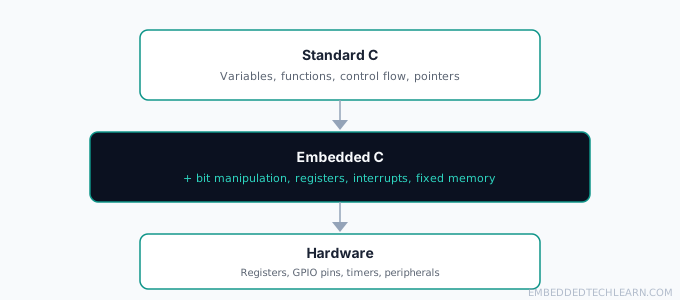
A simple way to think about it: Embedded C = standard C + direct hardware control. A desktop C program asks an operating system to open a file, allocate memory, or draw a pixel. Embedded C, running with no operating system underneath it at all in the common case, often talks straight to the hardware itself, flipping the exact bit in the exact memory address a datasheet says corresponds to a physical pin.
This isn't a formal language standard the way C99 or C11 are. No committee publishes an "Embedded C specification" that compilers must follow. It's a practical label the industry uses for how ordinary C gets applied in a specific context: compiled by a chip-specific cross-compiler, linked against a chip-specific startup routine instead of a general-purpose C runtime, and run on hardware that expects to be told, in exact detail, how to configure every peripheral it has. The language rules don't change, the assumptions the programmer can make about what's already set up and available absolutely do.
What Is an Embedded System?
An embedded system is a combination of hardware and software built to do one specific job, not to run arbitrary programs a user might install later. A washing machine's control panel, a microwave's timer, a car's anti-lock braking system, a traffic light controller, and a hospital infusion pump are all embedded systems: purpose-built, usually invisible to the person using them, and almost always running code written in Embedded C somewhere inside.
Five Features That Set Embedded C Apart
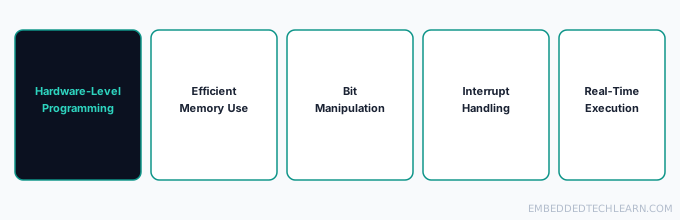
A handful of characteristics show up again and again in embedded C code, rarely all together in an ordinary desktop C program:
- Hardware-level programming: reading and writing specific memory addresses that correspond to real physical registers, not abstract variables.
- Efficient memory usage: working within a fixed, often small memory budget (kilobytes, sometimes just bytes), where every variable has a real cost.
- Bit manipulation: controlling individual bits within a register, since a single register often packs many unrelated hardware settings into one word.
- Interrupt handling: responding immediately to hardware events (a button press, a timer expiring, incoming data) rather than only checking for them in a loop.
- Real-time execution: guaranteeing that certain code runs within a predictable, bounded amount of time, critical when a missed deadline means a dropped sensor reading or a late brake signal.
The Structure of an Embedded C Program
Most embedded C programs share the same basic shape: a one-time setup section, followed by a loop that runs forever.
int main(void) {
    /* one-time setup: configure pins, peripherals, interrupts */

    while (1) {
        /* main loop: runs forever, this is the program's real "body" */
    }
    return 0;
}
That infinite while (1) loop isn't a bug, it's the point. There's no operating system to return control to when main() finishes, so on real hardware the program simply isn't supposed to end, it runs for as long as the device has power.
Bit Manipulation in Practice
Hardware registers are usually just one byte or word where individual bits each mean something different, bit 3 might control one pin, bit 4 a completely unrelated one. Setting a bit "on" without disturbing its neighbors, and clearing it again, is one of the most common operations in embedded C:
#include <stdint.h>

volatile uint8_t port = 0x00;  /* stands in for a hardware I/O port */

port |= (1 << 3);            /* set bit 3 (turn a pin on) */
/* port is now 0x08 */

port &= (uint8_t)~(1 << 3);  /* clear bit 3 (turn a pin off) */
/* port is back to 0x00 */
Compiled and run against a plain variable standing in for the port (a real hardware register can't be safely written from a desktop program), this produces exactly 0x08 after the set and 0x00 after the clear, confirmed by actually compiling and executing it rather than hand-tracing the bit math. On real hardware, port would instead be a volatile pointer to the exact memory address a microcontroller's datasheet assigns to that I/O port.
C vs. Embedded C, Briefly
At a glance: standard C typically runs on top of an operating system with gigabytes of memory to work with and reaches hardware only indirectly, through OS-provided APIs. Embedded C typically runs with no operating system at all, directly against a microcontroller with memory measured in kilobytes, reaching hardware by reading and writing its registers straight from code. For the full side-by-side comparison, including real code for both and a breakdown of exactly where performance and reliability differ, see C vs. Embedded C: What Actually Changes.
Advantages, Trade-offs, and Tools
Embedded C's directness is exactly where its strengths and its costs both come from. It compiles down to fast, compact code with no OS overhead sitting between the program and the hardware, and it gives precise, deterministic control over exactly what a chip does and when. That same directness means code is tied to a specific chip family (rarely portable without changes), debugging often means watching register values rather than stepping through friendly stack traces, and mistakes that a desktop OS would catch and contain (writing past the end of a buffer, say) can instead crash or brick the whole device.
Common tools for writing, compiling, and testing embedded C include Keil uVision and MPLAB IDE (chip-specific development environments), Proteus (a circuit simulator useful before touching real hardware), and the Arduino IDE (a beginner-friendly layer over embedded C/C++ for hobbyist boards). Across all of them, the same habits pay off: keep functions small and predictable, minimize memory footprint deliberately rather than as an afterthought, and comment hardware-specific assumptions clearly, since the next person reading a register-level line of code has no way to guess what a raw hex address means without a datasheet in hand.
The career side of this is worth naming plainly too, since it's usually the actual reason someone starts learning embedded C in the first place: it's the core skill behind IoT device development, robotics, automotive electronics, and industrial automation roles, fields that all need people comfortable reading a datasheet and turning it into working, reliable code, not just people who know C syntax in the abstract.
Real-World Examples
Example 1: A Washing Machine's Cycle Controller
The digital dial and display on a washing machine run entirely on embedded C, reading button presses, driving the motor and water valves in the right sequence, and timing each wash phase, all with no general-purpose operating system anywhere in the device.
Example 2: An Automotive Anti-Lock Braking System
A car's ABS controller reads wheel-speed sensors and modulates brake pressure many times per second, a textbook case where real-time execution isn't a nice-to-have, a late response measured in milliseconds is a safety failure, not just a slow app.
Example 3: A Hospital Infusion Pump
Medical infusion pumps use embedded C to precisely control dosing, monitor for blockages or air bubbles, and trigger alarms, code where both real-time guarantees and rigorous testing matter enormously, since a bug has direct patient-safety consequences.
Example 4: An Industrial Automation Controller
Factory equipment (conveyor belts, robotic arms, sensors on an assembly line) commonly runs embedded C on programmable controllers, coordinating physical machinery in lockstep with production timing that can't be allowed to drift.
Example 5: A Battery-Powered IoT Sensor Node
A small wireless sensor that wakes up periodically to take a reading and transmit it runs embedded C tuned aggressively for low power draw, since it may need to run for months or years on a single small battery with no one around to recharge or replace it.
Common Mistakes and Misconceptions
- Assuming Embedded C is a separate language from C. It's the same language and the same standard, used in a hardware-direct context with a chip-specific compiler.
- Assuming any C compiler can produce embedded firmware. A desktop compiler like plain gcc targets your desktop's own CPU and OS, a real embedded target needs a cross-compiler built for that specific microcontroller family.
- Using dynamic memory allocation out of habit.
malloc-style allocation is usually avoided in embedded C specifically because of fragmentation and unpredictable failure on devices that may run for years without a restart. - Treating Arduino sketches as the full picture of embedded C. Arduino's libraries are a convenience layer over real register-level embedded C, useful for learning, but understanding the raw registers underneath is what the language is actually built around.
Frequently Asked Questions
Is Embedded C a different language from C?
No, it's the same C language (the same syntax, the same standard library building blocks) used with hardware-specific extensions and a different compiler target. There's no separate 'Embedded C' standard the way there's a C99 or C11 standard, it's a practical label for how C gets used to program microcontrollers directly.
Is Embedded C hard to learn if I already know C?
The language itself isn't harder, but the mental model shifts: no operating system catching your mistakes, a fixed and often tiny amount of memory, and effects (a pin turning on, a motor spinning) you can physically observe instead of just text on a screen. Most of the real difficulty is learning to read a microcontroller's datasheet, not the C syntax itself.
Do I need special hardware to start learning Embedded C?
Not to start. Simulators like Proteus let you write and test embedded C logic without any physical microcontroller, useful for learning the language and concepts before buying real hardware. Eventually working with a real board (many are inexpensive) is worth it, since simulators can't fully capture real-world timing and electrical quirks.
What compiler do I need for Embedded C?
A cross-compiler that targets your specific microcontroller family, common examples include Keil C51 (for 8051-family chips), MPLAB XC (for Microchip PIC/AVR), and arm-none-eabi-gcc (for ARM Cortex-M chips). A standard desktop C compiler like gcc won't produce code that runs on a microcontroller directly, it targets your desktop's own processor and OS instead.
Is Arduino programming the same as Embedded C?
Very close. Arduino sketches are written in C/C++ and compiled down to real embedded C for the underlying microcontroller, but the Arduino framework wraps a lot of the raw register access in simpler library functions. Learning to read and write the raw register-level code underneath is what separates basic Arduino use from real embedded C proficiency.
Does Embedded C support object-oriented programming?
No, C itself has no classes or objects, that's a C++ feature. Some embedded projects do use C++ (with certain features like exceptions often avoided for size and predictability reasons), but plain Embedded C as covered here is pure C.
Why does Embedded C avoid dynamic memory allocation (malloc)?
Because heap allocation can fail unpredictably and fragment a tiny amount of RAM over time, both unacceptable in a system that might run for months or years without a restart. Most embedded C code allocates everything statically or on the stack, known and fixed at compile time, instead.
What is the difference between Embedded C and firmware?
Embedded C is the language; firmware is the actual compiled program that results and gets flashed onto the device. Not all firmware is written in C (some is assembly, some is C++ or Rust), but C remains the most common language firmware is written in across the industry.
Can Embedded C run without any operating system at all?
Yes, and this is actually the common case for smaller microcontrollers, called running 'bare-metal.' The program itself is the entire software running on the chip, there's no OS underneath scheduling it or providing services, main() effectively is the whole world.
Is Embedded C only used for small microcontrollers?
It's most associated with small microcontrollers, but the same register-level, direct-hardware-access style of C shows up in larger embedded Linux systems (writing device drivers, for instance) and even in parts of an operating system's own kernel.
What should I learn before starting Embedded C specifically?
A working knowledge of standard C (variables, pointers, functions, control flow) first, then bring in the hardware side: reading a simple microcontroller's datasheet, understanding registers and memory-mapped I/O (see What Is Computer Architecture and Basic Building Blocks of a Computer), and bitwise operators, which is what most register-level embedded C actually leans on.
References
- Embedded system: overview of what embedded systems are and where they're used.
- C (programming language): background on the base language Embedded C builds on.
- Bare machine: overview of running software with no operating system, the common embedded C case.