What You'll Learn
C and Embedded C are the same language wearing two very different hats. This tutorial breaks down exactly what changes between them: purpose, memory budget, hardware access, and performance guarantees, backed by real, compiled code on both sides rather than just a comparison table. It builds directly on What Is Embedded C? A Complete Guide, part of our Embedded C section.
On This Page
- The Same Language, Two Different Jobs
- Purpose and Execution Environment
- Memory: Gigabytes vs. Kilobytes
- Hardware Access: Indirect vs. Direct
- Two Programs, Side by Side
- Performance and Determinism
- When to Use Which
- Real-World Examples
- Common Mistakes and Misconceptions
- Frequently Asked Questions
- References
The Same Language, Two Different Jobs
C, developed by Dennis Ritchie, was designed as a general-purpose language: portable across machines, running on top of whatever operating system a computer happened to have. Embedded C isn't a fork or a dialect, it's the exact same language, deployed against a completely different set of constraints, no OS, tiny fixed memory, and real physical hardware sitting one register-write away.
Purpose and Execution Environment
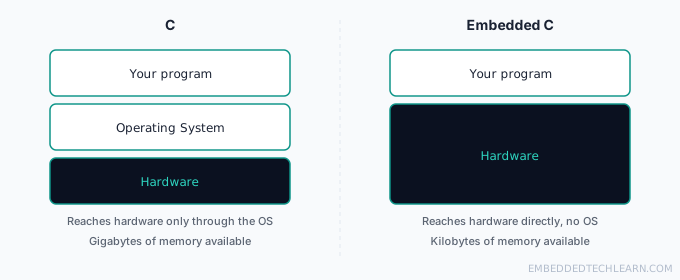
Standard C typically compiles to run on a desktop or server processor, under an operating system that schedules it alongside other programs, provides a filesystem, and manages memory on its behalf. Embedded C typically compiles for one specific microcontroller family and runs bare-metal: no scheduler, no filesystem, often no other program running at all. The compiled program is the entire software the chip runs, not one process among many.
Memory: Gigabytes vs. Kilobytes
A modern desktop running a C program typically has 8 to 32 gigabytes of RAM available system-wide. A small microcontroller running embedded C often has somewhere between 2 and 64 kilobytes of RAM, total, shared across every variable, buffer, and function call the entire program will ever make. That's a difference of roughly six orders of magnitude, not a rounding error.
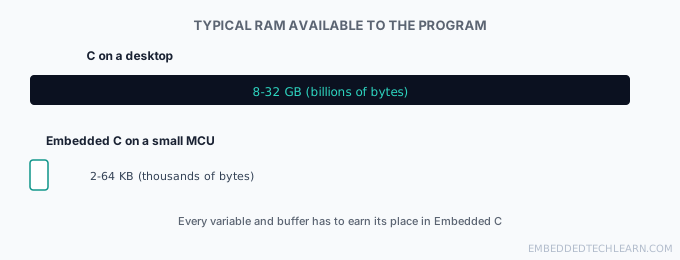
That gap changes how code gets written, not just how carefully. Dynamic memory allocation, recursion, and large local buffers, all routine in desktop C, become genuine risks in embedded C, where running out of stack or heap space has no graceful fallback, just a crash or corrupted memory. See The Memory Hierarchy Explained for why fast, on-chip memory is inherently this scarce and expensive compared to a desktop's DRAM.
Hardware Access: Indirect vs. Direct
Standard C reaches hardware only through layers the operating system provides: a file API to read a disk, a socket API to reach a network card, a graphics API to draw a pixel. Embedded C, running with nothing underneath it, frequently reaches hardware directly, writing straight to the memory address a datasheet documents for a given register, no API or driver in between.
Two Programs, Side by Side
A standard C program's most basic version needs nothing but the standard library:
#include <stdio.h>

int main(void) {
    printf("Hello, World!\n");
    return 0;
}
Compiled and run (verified with gcc rather than assumed), this prints exactly Hello, World!, relying entirely on the operating system to actually get that text onto a screen: the C code never touches a display, a driver, or any hardware at all, it just hands a string to the OS and trusts it to handle the rest. The equivalent embedded C action, turning on an LED, looks structurally similar but touches hardware directly instead of asking an OS for help:
#include <stdint.h>

#define LED_PORT (*(volatile uint8_t *)0x2000)

int main(void) {
    LED_PORT |= (1 << 0);   /* turn LED on */

    while (1) {
        /* embedded programs never return: there's no OS to return to */
    }
    return 0;
}
This second example is written for a real microcontroller target and compiles cleanly, but 0x2000 isn't a valid address on an ordinary desktop, so it's shown here for its structure and syntax, not something to actually execute on a PC. That's itself a real, practical difference worth noticing: standard C code is usually safe to compile and run anywhere; embedded C code is written for one specific target and generally isn't safe to run anywhere else.
Performance and Determinism
Raw speed almost always favors the desktop, a modern CPU vastly outperforms a microcontroller clock-for-clock. What embedded C offers instead is determinism: a guarantee that a specific piece of code takes a bounded, predictable amount of time, every single time. A desktop OS can pause your C program at any moment for another process, a garbage collector, or a scheduling decision, that unpredictability is exactly what many embedded applications (an airbag controller, a motor control loop) cannot tolerate at all.
This is also why embedded C code is written and reviewed differently. A desktop C program that occasionally takes twice as long to finish a task is usually just a minor inconvenience. Embedded C code that occasionally takes twice as long to service an interrupt can mean a missed sensor reading, a corrupted communication frame, or a motor left running a fraction of a second too long, so worst-case timing gets measured and budgeted deliberately, not left to average out.
When to Use Which
Standard C (or a higher-level language entirely) is the right tool when a program needs a filesystem, networking, a user interface, or portability across different machines, a desktop application, a server process, a command-line tool. Embedded C is the right tool specifically when code must run directly on constrained hardware with deterministic timing: firmware, device drivers, and anything controlling a physical process in real time.
Real-World Examples
Example 1: A Command-Line Utility
A file-compression tool written in standard C runs on whatever desktop or server it's compiled for, freely allocates memory as needed, and relies entirely on the OS for file access, exactly the environment standard C is built around.
Example 2: A Thermostat's Temperature Controller
A smart thermostat's core control loop, reading a temperature sensor and driving a relay, runs as embedded C directly on a small microcontroller, with no OS, a fixed and tiny memory budget, and a real-time requirement to check the sensor at a predictable interval.
Example 3: A Web Server Backend
A backend service written in C (or a language built on it) leans on the OS for networking, file access, and memory management constantly, the opposite end of the spectrum from bare-metal embedded C, and exactly why that OS layer matters so much here and so little on a microcontroller.
Example 4: A Drone's Flight Controller
A drone's flight controller runs embedded C reading gyroscope and accelerometer data and adjusting motor speed many times per second, real-time determinism isn't optional here, a late correction is the difference between stable flight and a crash.
Example 5: A Desktop Photo Editor
A desktop image editor written in C allocates memory freely for each open image, relies on the OS for file dialogs and rendering, and can safely use large stack frames and recursive algorithms, all routine in standard C, all risky assumptions in embedded C.
Common Mistakes and Misconceptions
- Assuming Embedded C is strictly a subset of C. It's the full language, used with hardware-specific practices and often a smaller standard library, not a deliberately restricted version of C.
- Assuming performance always favors Embedded C. Raw computational speed almost always favors the desktop; embedded C's real advantage is predictable, bounded timing, not faster execution.
- Writing embedded C like desktop C out of habit. Reaching for
malloc, deep recursion, or large stack buffers without a second thought works fine on a desktop and can quietly crash a memory-constrained microcontroller. - Assuming code has to be rewritten from scratch to move between the two. Well-organized embedded projects separate hardware-independent logic from register-specific code precisely so the portable parts don't have to be.
Frequently Asked Questions
Do I need to learn standard C before Embedded C?
Yes, effectively. Embedded C is standard C plus hardware-specific practice, not a separate language to learn from scratch. Solid footing in variables, pointers, functions, and especially bitwise operators before moving to register-level embedded code makes the transition far smoother.
Can Embedded C do everything standard C can?
Syntactically, yes, the same language features are available. Practically, no: without an OS or a large heap, things standard C programs take for granted (opening files, allocating memory freely, printing to a console) either don't exist or have to be built from scratch for that specific hardware.
Why is memory so much more limited in Embedded C?
Because the target hardware itself has far less of it, physically. A desktop has gigabytes of DRAM; a small microcontroller often has only a few kilobytes of SRAM total, shared between every variable, buffer, and the call stack combined. See The Memory Hierarchy Explained for why memory this small and fast costs so much more per bit than a desktop's RAM.
Does Embedded C run faster than regular C?
Not inherently, a desktop CPU is almost always far faster in raw terms than a microcontroller. What Embedded C offers instead is predictability, a guarantee about the worst-case timing of a specific operation, which regular desktop C running under a general-purpose OS usually cannot promise.
Is it true that Embedded C code cannot use standard library functions?
Not entirely true, but many standard library functions assume things (a filesystem, a heap, a console) that don't exist on bare-metal hardware, so a lot of embedded C either avoids them or relies on a cut-down embedded-specific library implementation instead.
Why does Embedded C avoid printf-style output?
printf() depends on a console or serial output existing and configured, and it also pulls in a surprisingly large amount of code and stack space for formatting, both expensive on a memory-constrained chip. Embedded projects that do need text output often implement a minimal version themselves, or route it through a UART instead of a console.
What happens if Embedded C code has a bug that a desktop OS would normally catch?
It can crash the entire device (a hard fault, a hang, or a full reboot) instead of just the one offending program, since there's no OS process boundary containing the damage. This is exactly why testing and defensive coding matter more in embedded C, not less.
Is it worth learning standard C deeply if I only care about embedded work?
Yes. Every embedded-specific skill (registers, interrupts, memory-mapped I/O) is built on top of ordinary C fundamentals, pointers most of all. Skipping straight to hardware-specific tricks without a solid grasp of plain C tends to produce code that works by accident rather than by understanding.
Can the same source code run as both regular C and Embedded C?
Rarely without changes. Code that touches hardware registers or relies on a specific memory layout is tied to that target. Well-organized embedded projects do separate hardware-independent logic (portable) from hardware-specific register access (not portable) specifically to keep as much code reusable as possible.
Does Embedded C support floating-point math?
It's available in the language, but many smaller microcontrollers have no dedicated floating-point hardware, so floating-point operations get emulated in software, considerably slower and larger than integer math. Embedded C code often deliberately sticks to fixed-point or integer arithmetic for exactly this reason.
Which should I learn first if I want to get into embedded systems?
Standard C first, thoroughly, then move into embedded-specific concepts (registers, memory-mapped I/O, interrupts) once pointers and bitwise operators feel comfortable. Trying to learn both at once tends to blur which difficulty is coming from the language and which is coming from the hardware.
References
- C (programming language): background on standard C and its design goals.
- Embedded system: overview of the hardware embedded C typically targets.
- Real-time computing: detail on the determinism guarantees embedded systems often require.